SD-002 / SYSTEM DEVELOPMENT
Cycloidal Drive
TIMELINE
SEP–DEC 2024
PROJECT TYPE
PROTOTYPE DEVELOPMENT
KEY IDEA
COMPACT HIGH-RATIO REDUCTION
FOCUS
REAL-WORLD HARDWARE INTEGRATION
CAD RENDERS / ASSEMBLY
2 VIEWS


01 / WHY IT MATTERS
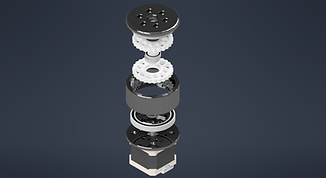
A cycloidal drive provides a large speed reduction within a compact package by using an eccentric input to move a cycloidal disc against a fixed ring of pins. The difference between the number of lobes on the disc and the surrounding pins creates the reduction ratio.
Unlike a conventional gear pair, multiple contact points can share the load at the same time. This makes cycloidal drives useful in systems that require compact packaging, high torque, and relatively low backlash, including robotic joints and precision motion systems.
02 / MY OBJECTIVE
My goal was to understand another alternative to a conventional gear train and study how geometry could create a high reduction ratio without using several separate gear stages.
As with the Capstan Drive project, I wanted to move beyond reproducing a mechanism visually. I focused on understanding the motion, the purpose of each component, the load path, and how the complete assembly would need to be supported and manufactured.
03 / TRANSITION TO REAL-WORLD HARDWARE
This project also marked a transition away from relying only on VEX components. Educational robotics hardware was valuable for learning, but real engineering systems require broader experience with commercially available motors, bearings, fasteners, shafts, and interfaces.
I purchased a stepper motor and appropriate screws so the design could be developed around components more representative of real robotic and automation systems. This required me to model actual mounting patterns, shaft dimensions, fastener clearances, bearing fits, and assembly constraints rather than designing around one standardized educational construction system.
The project strengthened my understanding of component sourcing: selecting parts from outside one ecosystem, interpreting dimensions and specifications, and adapting the surrounding design so independently sourced components could function together.
04 / SYSTEM DEVELOPMENT + CAD
Modeling the drive helped me practice building a complete mechanical assembly rather than an isolated part. The system required an eccentric input, cycloidal discs, output pins, bearings, shafts, fasteners, structural supports, and a motor interface to work together with appropriate alignment and clearance.
I used the original mechanism as a technical reference, then rebuilt and adapted the assembly in CAD with my own design decisions and visual style. This helped me practice interpreting an existing engineering concept while still making deliberate choices about packaging, assembly, and component integration.
The process reinforced that a mechanism can be theoretically correct but still fail as a physical system if bearing support, tolerances, fastening, or assembly access are overlooked.
05 / NEXT APPLICATION
I plan to apply the cycloidal drive to a future robotic-arm system, where its compact reduction ratio and torque capability could be useful at one or more joints.
Integrating the drive into a complete arm would allow me to study motor sizing, joint loading, structural stiffness, bearing support, position sensing, and closed-loop control in addition to the transmission itself.
I also want to compare the cycloidal drive with the Capstan Drive to determine where each mechanism is most appropriate. The cycloidal drive may be better suited for compact high-ratio torque multiplication, while the capstan drive may be advantageous where smooth motion and very low backlash are the main priorities.