ME-005 / RAPID ROBOT DEVELOPMENT
VEX Robotics Competition Robot
TIMELINE
AUG 2021–MAY 2025
EXPERIENCE
4 COMPETITION SEASONS
FINAL-SEASON OUTPUT
4 MAJOR CONFIGURATIONS
FASTEST BUILD
GROUND-UP ROBOT / 48 HOURS
ROBOT EVOLUTION / FINAL-SEASON CAD ITERATIONS
3 VIEWS
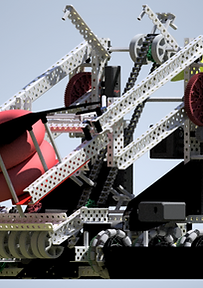
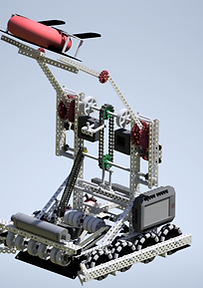
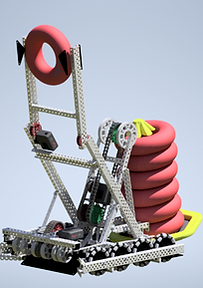
01 / RAPID DEVELOPMENT CHALLENGE
Competitive robotics rewards the ability to identify a weak design, replace it quickly, and return with a more capable machine before the next event.
I participated in VEX Robotics throughout all four years of high school. My early seasons established the mechanical, programming, and competition foundation that allowed me to independently manage the complete robot-development process by senior year. During that final eight-month season, I produced nearly four major robot configurations by repeatedly moving through strategy, CAD, construction, C++ programming, testing, and competition feedback.
02 / FOUR-YEAR PROGRESSION
My VEX experience developed across four competition seasons.
Freshman year — Foundation. I learned the VEX construction platform, introductory programming, competition workflow, and the relationship between robot design and match performance.
Sophomore and junior years — Increasing responsibility. I became more involved in design, construction, programming, testing, troubleshooting, and match preparation while developing stronger technical judgment.
Senior year — Full-system ownership. I independently managed strategy, complete robot CAD, physical construction, C++ programming, PID control, autonomous routines, driver controls, testing, tuning, and major architectural redesigns.
The final season represents the most complete expression of the skills developed during the previous three years.
03 / COMPETITION CONTEXT
VEX Robotics Competition requires participants to develop a robot around a game-specific field, scoring system, and endgame objective. The robot must perform during both autonomous and driver-controlled portions of a match while remaining within the competition’s dimensional, hardware, and inspection constraints.
A successful robot must do more than demonstrate a mechanism once. It must score consistently, respond predictably, survive repeated matches, and support a clear strategy against different opponents.
Each major redesign therefore began with strategic questions: which actions created the greatest scoring value, which weaknesses were limiting performance, and whether the current architecture could be improved or needed to be replaced.
04 / DESIGN–BUILD–PROGRAM LOOP
During my final season, I independently managed the full robot-development loop.
Strategy. I evaluated scoring priorities, match flow, likely opponent behavior, and which robot actions needed to be the most reliable.
CAD. I translated those priorities into complete robot layouts, mechanism geometry, component interfaces, structural decisions, and packaging.
Construction. I physically built and assembled the robot, integrated mechanisms, corrected alignment and fit issues, and revised hardware when the real assembly exposed problems that were not visible in CAD.
Programming. I wrote the robot code in C++, developed driver controls, programmed autonomous routines, and integrated sensor feedback.
PID control. I implemented and tuned PID-based control where open-loop motor commands were not repeatable or accurate enough.
Testing and iteration. I evaluated mechanism consistency, control response, autonomous accuracy, and match readiness, then used those results to determine whether to revise the current architecture or begin a larger rebuild.
05 / RAPID PROTOTYPING + ARCHITECTURAL EVOLUTION
Rapid prototyping became the defining engineering method of my final season. Instead of preserving a design simply because significant time had already been invested in it, I treated each robot as a temporary solution that could be revised or replaced when testing revealed a stronger direction.
During approximately eight months, I produced nearly four major robot configurations. The early-season robot established the first complete competition architecture, the mid-season version represented a substantial redesign, and the final states robot combined the strongest lessons from the previous iterations.
Each redesign was driven by a specific limitation involving mechanical behavior, autonomous performance, reliability, serviceability, or match effectiveness. This process taught me that iteration does not always mean modifying one part; sometimes the most effective improvement is replacing the entire system architecture.
06 / FULL-STACK DEVELOPMENT + 48-HOUR BUILD
I independently managed the complete robot-development process, including strategy, CAD, construction, electronics integration, C++ programming, driver controls, autonomous routines, PID implementation, testing, and troubleshooting.
One of the most demanding iterations was a complete robot designed and built from the ground up in approximately 48 hours. The compressed schedule required aggressive prioritization: the robot had to be simple enough to construct immediately while still supporting the intended competition strategy.
Mechanical and software development occurred concurrently. I moved continuously between CAD, physical construction, wiring, programming, and testing, with each physical result affecting the code and each control test revealing new mechanical requirements.
PID control was used where repeatability and positional accuracy were important. Tuning required balancing speed, overshoot, oscillation, and stability while accounting for mechanical factors such as friction, backlash, structural flex, and changing loads.
Strategy connected the complete system. It defined which actions mattered most, mechanical design created those capabilities, and autonomous and driver-control software made them repeatable in competition.
07 / FINAL OUTCOME + ENGINEERING GROWTH
The final robot represented the culmination of four years of VEX experience and one season of especially aggressive development. It incorporated the strongest lessons from nearly four major configurations: faster redesign, more deliberate strategy, closer integration between CAD and physical construction, stronger C++ control, and a greater willingness to replace weak architecture instead of continuing to patch it.
The most important outcome was not one isolated mechanism. It was the ability to independently move from competition strategy to a complete functioning robot through a repeatable design–build–program–test process.
VEX also taught me that rapid prototyping is only useful when each iteration answers a specific engineering question. Rebuilding creates progress when the new design directly addresses a known limitation.
By my final season, I was independently responsible for complete robot CAD, mechanism design, construction, electronics integration, C++ programming, PID tuning, autonomous development, driver controls, testing, troubleshooting, and strategic redesign. My earlier seasons provided the foundation for this level of full-system ownership.
FINAL BUILD / COMPLETE ROBOT
TOOLS + TECHNOLOGIES